
Fierce Deity Armor in TOTK: How to Get All Three Pieces
Fierce Deity Armor in TOTK: How to Get All Three Pieces
The Fierce Deity Armor in TOTK is a melee-focused armor set that pulls its look directly from Link’s transformation in Majora’s Mask, and unlike most sets in Hyrule it is gated behind a connected quest rather than dropped by a single boss. You start the sequence at one chest in the Eldin region, then travel to three separate Akkala caves and ruins to collect the mask, chest piece, and boots. After the third piece is in your inventory, the original chest unlocks a bonus two-handed sword, so the set only delivers its full design promise when you commit to the whole loop.
This guide breaks the set down into the parts a player actually needs to plan: where the quest begins, where each armor piece is hidden, which cave puzzles gate each chest, what to bring for the upgrade path at the Great Fairy Fountains, and where the set sits among TOTK’s other melee builds. The information below is built from one detailed walkthrough of the questline plus the general upgrade rules that govern every armor set in the game, so the locations, items, and upgrade logic are consistent with how the set is documented rather than reconstructed from memory.
What the Fierce Deity Armor set actually does
Every piece of the Fierce Deity Armor in TOTK is a combat-oriented item rather than a utility piece. The set is themed around charged melee hits and two-handed weapons, which shapes both how you play with it equipped and which enemies it is worth wearing it against. The trade-off, as with most themed sets, is defense, so the pieces are most useful when you have already learned the encounter rather than when you are still learning it.
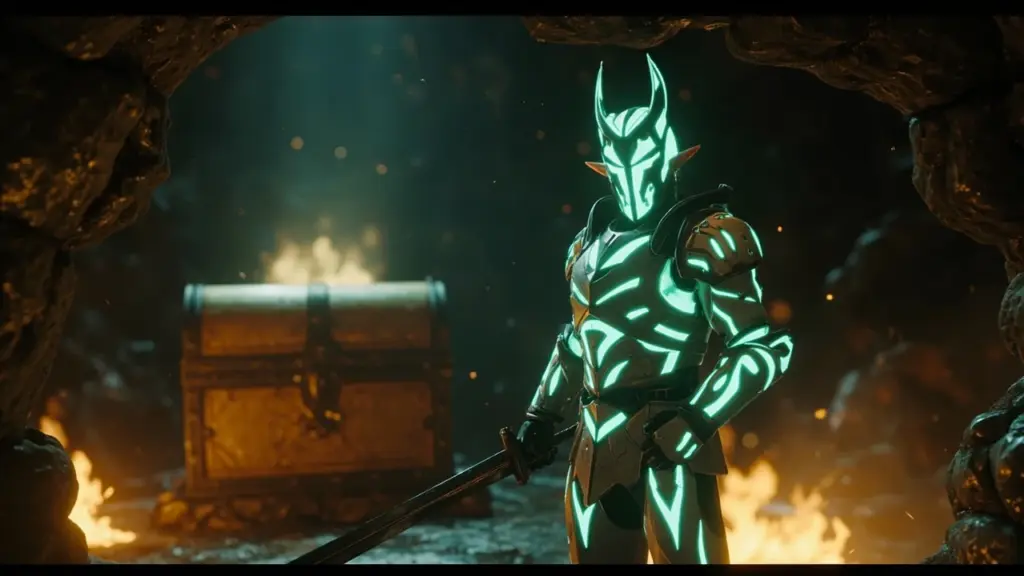
The visual identity is the other half of the value. The mask echoes Link’s Majora’s Mask transformation with sharp, angular plate lines and a glowing teal accent, and the chest and boots carry the same motif so the set reads as a single silhouette on screen. If you care about the aesthetic in addition to the stats, that is part of the reason to complete the full collection rather than settling for a single drop.
Set bonus and combat role
Wearing all three pieces of the set together unlocks a melee-focused bonus that scales with upgrades. The practical effect is a noticeable jump in damage when you swing one-handed or two-handed weapons while the full set is equipped, which is the reason most players treat it as a boss or elite-camp set rather than an exploration set. The set also pairs with attack-boosting meals and elixirs, so the effective damage ceiling is higher than the raw numbers on the armor screen suggest.
The trade-off is that defense is lower than what you would get from a comparable point in a heavy or generalist set, so you take more damage per hit while the bonus is active. Players who rely on flurry rushes, parries, or bow play will not get full value from the bonus because the effect keys on melee swings rather than on hit-and-run tactics.
Visual identity and lore flavor
The look is a direct callback to the Fierce Deity’s Mask transformation in Majora’s Mask, which is a deliberate piece of fan-service design. The chest and boots are styled to match the mask so the silhouette reads as a single armor identity from any camera distance. Wearing the full set is the only way to see the complete design, which is part of why a half-completed set looks visually incomplete in screenshots and clips.
For players who remember the original Amiibo-only unlock in Breath of the Wild, the TOTK version is also a small piece of continuity because the look is preserved while the acquisition path changes. That is the kind of detail that matters more to long-time Zelda players than to a new player approaching the set purely as a stat choice.
How to start the Fierce Deity Armor quest in TOTK
The quest does not appear in your adventure log as a named entry. It begins when you open a specific barred chest in the Eldin region and read the message inside, which tells you that the full set must be assembled before the legendary sword attached to the set can be claimed. Once you read that message, the side quest is technically active even though nothing has been formally added to the quest log.
Because there is no journal entry, it is easy to walk past the starting chest without realizing it begins a multi-step sequence. The fastest way to confirm you are in the right place is the combination of the location, the barred chest, and the cryptic text that mentions the sword.
Starting chest: Cephla Lake Cave
Travel to Cephla Lake Cave, which is located in the Eldin region. Inside the cave you will find a chest sealed behind a barred gate that cannot be opened at this stage of the sequence. Interact with the chest to receive the cryptic message that you need to bring the full set together before the gate will open, and that the reward for doing so is the Fierce Deity Sword. That interaction is the official start of the quest.
Do not skip this step. Several online walkthroughs treat the quest as starting at the first armor piece, but the in-game trigger is the message inside this specific chest. Players who collect the armor pieces first and then return to open the chest will still complete the sequence, but they will miss the early cue that the three caves and ruins are part of one connected objective.
Quest scope and order of operations
After the starting message, the operational order is: collect the mask, collect the chest piece, collect the boots, then return to Cephla Lake Cave to open the now-unlocked chest and receive the sword. The three pieces are independent in the sense that you can visit the three locations in any order, but they are dependent on the quest being active in the sense that returning to the original chest before collecting all three does nothing.
There is no soft-lock if you pick the pieces up out of order. The gating is on the barred chest, not on the individual pieces, so the quest simply waits for you to finish the collection step. This makes the set relatively forgiving for players who find a piece by accident and only later realize it is part of a larger set.
Where to find every piece of Fierce Deity Armor
All three pieces are located in the Akkala region, which is northeast of central Hyrule and is reachable from most map edges without crossing major quest walls. The three sites are: Ancient Tree Stump Cave for the mask, Akkala Citadel Ruins for the chest piece, and Skull Lake Cave for the boots. Each location is a small self-contained puzzle with a single armor piece as the reward.
Because the pieces are spread across caves and ruins, you will need to manage heat, gloom, and enemy density as you move between them. The Akkala region is a good candidate for an upgrade pass since you will already be moving through it.
Mask: Ancient Tree Stump Cave
To reach the mask, travel southeast of the Tarin Wetlands and look for a hollow tree. The exterior looks like a normal landmark until you break the breakable rocks or detonate Bomb Flowers at the base, which reveal a secret interior. Inside, clear the wave of enemies and move the rubble to reach the chest that contains the Fierce Deity Mask.
The mask is the first piece most players find because the Tarin Wetlands landmark is easy to reach from the main Akkala roads, but the cave is also easy to miss because the entrance is hidden behind a destructible surface rather than a visible cave mouth. Marking the tree on your map after you clear the rubble is a good idea so you can return later if you forget which one held the mask.
Chest piece: Akkala Citadel Ruins
Navigate to the upper levels of the Akkala Citadel Ruins, which sit on a hill overlooking the Akkala Sea. Be cautious of gloom patches and enemy ambushes on the climb, because the ruin is set up so that enemies can knock you off the upper platforms if you rush. The puzzle in the main hall is to light the torches around the central statue, which unlocks the door to the chest piece.
If you do not already have a fire source or a flint in your inventory, the torch puzzle is the point at which the chest piece stops being free. A single fire arrow or a flame-emitter weapon will light all the braziers in a single pass, so it is worth equipping one before the climb rather than improvising at the top.
Boots: Skull Lake Cave
Head toward the western eye of Skull Lake and locate the cave entrance near the water line. The interior is gloom-filled and is guarded by a group of Lizalfos, which means you will need either a gloom-healing meal or a clear plan to avoid touching the floor where the gloom pools sit. Defeat the Lizalfos and traverse the tunnels to reach the boots chest at the back.
Skull Lake Cave is the most punishing of the three sites because gloom damage is a constant threat and the Lizalfos will use the gloom as a retreat. Sun-pumpkin meals or a gloom-resistance elixir will neutralize most of the floor damage, and a one-handed weapon keeps the fight short if a Lizalfos closes the distance.
Fierce Deity Armor set locations at a glance
| Piece | Region | Site | Access hint | Main hazard |
|---|---|---|---|---|
| Mask | Akkala | Ancient Tree Stump Cave | Break rocks or use Bomb Flowers at the hollow tree southeast of Tarin Wetlands | Enemy wave and rubble |
| Chest piece | Akkala | Akkala Citadel Ruins | Climb to upper levels and light torches around the central statue | Gloom patches and enemy ambushes |
| Boots | Akkala | Skull Lake Cave | Enter the cave near the western eye of Skull Lake | Gloom pools and Lizalfos ambushes |
| Sword reward | Eldin | Cephla Lake Cave | Return after collecting all three armor pieces | None, chest is unlocked by the quest |
Unlocking the Fierce Deity Sword
Once you have collected the mask, chest piece, and boots, return to the barred chest at Cephla Lake Cave. The chest will now open and grant the Fierce Deity Sword, a powerful two-handed blade that synergizes with the full set. The sword is the only reward attached to the original chest, so the visit is worth making even if you primarily care about the armor.
Because the sword is a two-handed weapon, it shares the inventory slot with other two-handed blades such as the Lynel weapons you may already be carrying. Plan your inventory before you return to Cephla Lake Cave so you do not have to drop a higher-tier weapon to make room for the new one.
Why the sword is the real prize
Two-handed weapons are the damage ceiling for melee builds in TOTK, and the Fierce Deity Sword sits in that category with a damage profile that benefits from the set bonus. The combination of full set plus two-handed sword is the version of the build that turns a tough boss into a manageable fight, and the sword is also a strong standalone weapon if you choose to wear a different armor set.
The sword is also a collectible piece of the Majora’s Mask callback, which is a smaller consideration for some players but matters for completionists. Returning to Cephla Lake Cave to claim it is the only way to formally close the quest, and it is the only step that requires the full set rather than just one piece.
Upgrading the Fierce Deity Armor
Each piece of the set can be enhanced at the Great Fairy Fountains, which are the only in-game vendors for armor upgrades. The upgrade path is the same as for any other set, but the materials required at the higher tiers are rarer than what you would need for a generic set, so the upgrade curve is steeper than for utility pieces. The first tier is cheap; the final tier is the material wall most players hit.
Upgrade costs scale by tier, and the higher tiers ask for monster parts and rare drops that you would otherwise use for elixirs. If you are short on monster guts, plan an upgrade route in advance so you do not burn materials on a lower-tier armor that you plan to replace.
Materials you will need
For a full upgrade you will need rare monster drops such as Hinox Guts and Lynel Guts, plus the usual Bokoblin and Lizalfos parts for the lower tiers. Hinox Guts come from the larger Hinox variants in the Akkala and Hebra regions, and Lynel Guts come from the silver and white-maned Lynels that appear in the post-game scaling zones. Both are common bottlenecks for the final upgrade.
Dragon parts are not required for the armor itself but are useful for elixirs that complement the melee build, so they are worth tracking while you hunt the bigger monster parts. Star fragments and large zonaite bundles are useful backups if you are farming the higher-tier monster parts in the depths.
How upgrades change the set’s role
Each tier adds defense, and the final tier raises the set bonus damage enough that the build starts to compete with the highest-damage melee options in the game. At full upgrade, the set is one of the strongest melee options available, which is the trade-off the developers baked into the harder material cost. If you are not planning to push to the final tier, the set is still good but is not differentiated from a generic melee set at lower tiers.
For most players the meaningful breakpoints are the second and fourth tiers, where the defense gains and the set bonus start to feel worth the materials. The final tier is a luxury that is most useful for boss rushes and very-hard mode replays, where the extra damage per swing compounds over a long fight.
How the Fierce Deity Armor compares to TOTK’s other melee sets
The Fierce Deity Armor in TOTK is one of several melee-focused sets in the game, alongside the Barbarian set, the Phantom Ganon set, and the Evolved Yiga set. Each of those sets has a different trade-off between raw attack, defense, and utility, so the right pick depends on the encounter rather than on a single number.
The Fierce Deity set sits on the cosmetic and theme side of the comparison, which matters because the Barbarian set has higher raw attack at the cost of any set bonus, while the Evolved Yiga set adds a stealth and mobility layer that the Fierce Deity set does not. The Phantom Ganon set is the closest in theme and is a viable alternative if you cannot commit to the Fierce Deity material grind.
Fierce Deity Armor vs other melee sets
| Set | Main bonus | Defense profile | Best weapon pairing | Acquisition cost |
|---|---|---|---|---|
| Fierce Deity Armor | Melee attack bonus when full set is worn | Medium, scales with upgrades | Two-handed swords, including the Fierce Deity Sword | Three Akkala locations plus a quest chain |
| Barbarian set | Flat attack bonus per piece, no full-set gate | Low | Two-handed weapons, clubs | Three labyrinths and one cave, no quest |
| Phantom Ganon set | Phantom Ganon-themed attack bonus at full set | Medium | One-handed swords, royal weapons | Hyrule Castle, multiple stealth encounters |
| Evolved Yiga set | Stealth, mobility, and a small attack bonus | Medium | One-handed blades, wind-cleaving weapons | Yiga Clan hideout questline |
When the Fierce Deity set is the right call
Pick the Fierce Deity Armor in TOTK for boss fights where you can commit to a melee pattern and want the set bonus to compound across a long engagement. The full set plus a fully upgraded Fierce Deity Sword is the build that maximizes damage per swing, and the visual identity is a bonus on top of the numbers.
Avoid the set for exploration and early-game encounters where defense matters more than peak damage, because the lower defense and the gloom-heavy Akkala caves make it a poor fit for learning new enemy patterns. The set is also a poor fit if you do not yet have the Great Fairy Fountains unlocked, because the un-upgraded set is not differentiated from a generic melee set.
How the TOTK version differs from Breath of the Wild
In Breath of the Wild, the Fierce Deity Armor was an Amiibo-exclusive set, which meant most players never wore it in a real playthrough. The TOTK version moves the set fully in-game, so the look and the theme are no longer gated behind a toy. The change is meaningful for players who care about the Majora’s Mask reference and who want a non-Amiibo path to the look.
Stat-wise, the TOTK version is also tuned higher than its BOTW counterpart, with a stronger synergy with two-handed weapons and a higher damage ceiling on the sword reward. The two are not directly comparable on a single number, but the TOTK set is the stronger of the two at the equivalent upgrade tier.
Tips for a faster Fierce Deity Armor run
Because the three pieces are in the same region, the set is one of the more efficient multi-piece collects in TOTK. The fastest route is to fast-travel to the Akkala tech lab or to the Tarin Wetlands shrine, then walk the caves and ruins in a single loop. That keeps travel time down and lets you bring one set of consumables for the gloom damage and one set of weapons for the enemy waves.
It is also worth doing the run after you have unlocked at least one Great Fairy Fountain, because the cave run produces a lot of monster parts as a side effect. The materials you collect on the way to each piece will cover the first upgrade tier, which makes the set usable immediately rather than as a long-term project.
Pre-flight checklist for the Akkala loop
Before you start the loop, make sure your inventory has a fire source for the Akkala Citadel torches, at least one gloom-resistance meal, and a one-handed weapon for tight caves. The fire source solves the torch puzzle in a single pass, the gloom meal prevents the Skull Lake floor from eating your hearts, and the one-handed weapon handles the Lizalfos ambushes without exposing you to long recovery windows.
It is also worth carrying a single Bomb Flower or a fused bomb weapon for the Ancient Tree Stump entrance. The destructible rock at the base of the tree is a one-time cost, and carrying the right tool saves you the round trip to a nearby plant.
Common mistakes to avoid
The single most common mistake is treating the three pieces as three independent quests and missing the connection to the Cephla Lake Cave chest. Players who collect the pieces and then never return to the Eldin region will never get the sword, which is the only step that requires the full set. A second common mistake is upgrading the pieces one at a time without planning the material curve, which leaves the player stuck at the second tier with no Hinox Guts and no path to the third.
A third mistake is fighting the Lizalfos in Skull Lake Cave without a gloom-resistance meal, which turns a short fight into a slow resource drain. The meal is cheap relative to the time it saves, and the cave is small enough that one Sun-Pumpkin meal covers the entire interior.
Frequently asked questions
Do I need the Majora’s Mask Amiibo to get the Fierce Deity Armor in TOTK?
No. The TOTK version of the set is fully in-game, and you do not need any Amiibo to obtain any of the three pieces. The Amiibo was the only path in Breath of the Wild, but the move to a normal quest chain is one of the main differences between the two versions of the set.
Is the Fierce Deity Armor in TOTK a good set for beginners?
It is a medium-tier set for beginners in the sense that the locations are accessible, but the pieces are best used after you have unlocked at least one Great Fairy Fountain for upgrades. Without upgrades the set does not out-perform a generic melee set, so the value of the early collect is mostly cosmetic until you push through the upgrade path.
Where do I start the Fierce Deity Armor quest?
You start by visiting Cephla Lake Cave in the Eldin region and interacting with the barred chest. The message inside the chest is the in-game trigger, and the quest does not appear as a named entry in your log. After that, the three armor pieces are in the Akkala region at the locations described above.
Can I get the pieces in any order?
Yes. The three pieces are independent, and you can visit Ancient Tree Stump Cave, Akkala Citadel Ruins, and Skull Lake Cave in any order. The only step that requires the full set is the final return to Cephla Lake Cave to unlock the sword, so the order you pick up the pieces does not matter for completion.
What is the best weapon to pair with the Fierce Deity Armor?
The Fierce Deity Sword is the natural pairing because it shares the set’s theme and benefits directly from the set bonus. Other strong two-handed options include high-damage Lynel weapons, but the Fierce Deity Sword is the only one that is gated behind the same quest chain, so it is the most thematically complete pairing.
How many Great Fairy upgrades does the set need to feel strong?
The first two upgrade tiers give the set enough defense to feel comfortable in regular combat, and the third and fourth tiers are where the set bonus damage starts to out-perform a generic melee set. The final tier is a luxury that is most useful for boss rushes and very-hard mode replays, where the extra damage per swing compounds across a long fight.
What materials do I need for the final upgrade tier?
The final upgrade tier asks for rare monster parts including Hinox Guts and Lynel Guts, plus the usual Bokoblin and Lizalfos parts that you would need for the lower tiers. If you do not already have a stockpile of Hinox Guts and Lynel Guts, plan a farming route through the Akkala and Hebra regions before you start the upgrade pass.
Does the Fierce Deity Armor in TOTK stack with attack-boosting meals?
Yes. The set bonus stacks with attack-boosting meals and elixirs, so the effective damage ceiling is higher than the raw armor numbers suggest. This is the main reason the set is a strong boss-fight choice rather than an exploration choice: the bonus compounds with consumables, which is most useful in fights where you can commit to a melee pattern for the full duration.
Is the Fierce Deity Sword worth a separate trip back to Eldin?
Yes. The sword is a strong two-handed weapon in its own right and is the only reward gated behind the full set. The trip to Cephla Lake Cave is short once you have a fast-travel point in the Eldin region, and the sword is the only step that formally closes the quest chain.
How does the TOTK Fierce Deity Armor compare to the Phantom Ganon set?
Both sets are melee-focused and have a similar defense profile, but the Phantom Ganon set has a royal-weapon theme that pairs better with one-handed swords, while the Fierce Deity set pairs better with two-handed weapons. The right pick depends on whether you prefer one-handed or two-handed combat, and whether you want the Majora’s Mask reference or the Phantom Ganon visual identity.

Leave a Reply